Before You Pay $1,000 for an LSAT Course, Read What You're Actually Paying For
If you're weighing a prep course against self-study and the price tag is making your stomach turn — here's the breakdown nobody in the industry wants you to see before you commit.


You've got the checkout page open in one tab. Blueprint, 7Sage, Kaplan — pick one. The number staring back at you is somewhere north of $1,000.
And in another tab, you've got a spreadsheet. Or maybe it's the back of a notebook. Either way, you're doing the math. Rent. Groceries. Application fees — plural, because you're not applying to just one school. LSAC charges alone will eat a few hundred dollars before you've answered a single question.
So you sit there. And you do what every smart person does before spending a thousand dollars they're not sure they have: you hesitate. Good. Because that hesitation? It's not weakness. It's not you being cheap. It's your brain doing exactly what it should — asking whether the price matches the value.
Here's the thing nobody in the LSAT prep industry brings up at that moment: you're not comparing methods. You're comparing price tags that were set by marketing departments.
The courses know you're anxious. They know this test feels like a gate between you and everything you've been working toward. They know that when the stakes are this high, most people will pay whatever number is put in front of them — especially if the alternative feels like going in alone.
And that anxiety? That's not a bug in their business model. That's the feature.
The question isn't whether you can afford a $1,000 course. Plenty of people figure out the financing somehow — credit cards, loans, a parent's savings account they feel guilty about. The real question is what you're actually buying for that $1,000. Because once you see the breakdown, the hesitation you're feeling right now starts to look less like doubt and more like the smartest instinct you've had in this entire process.
Here's What $1,000 Actually Buys You (It's Not What You Think)

Let's be specific about where that money goes. Not emotional. Just honest.
Every major LSAT course teaches some version of the same core process: learn to decode question types, build a reasoning framework, practice reading with precision, learn to spot trap answers, drill systematically, and perform under timed pressure. That's it. That's the method. It's not proprietary. It's not secret. It's the fundamental architecture of LSAT mastery, and any experienced prep strategist will tell you the same six-stage structure exists across every credible program.
So what are you actually paying the premium for?
Marketing. Those courses spend enormous budgets making sure their ad is the first thing you see when you Google "LSAT prep." That spend gets baked into your tuition.
Tutor payroll. Group classes, office hours, chat support — staffed by people who need salaries. Whether you use those hours or not, you're subsidizing them.
The manufactured belief that you can't do it alone. This is the expensive one. The entire pricing structure depends on you believing that without their hand-holding, you'll fail. That self-study is reckless. That the method is too complex to follow in a book.
It isn't.
Improving your score requires you to fundamentally change the way that you read and think… look for steps or processes that you're trying to shortcut.— r/LSAT
That's the real work. And notice — it's a process. A structured, followable process. Not a classroom experience. Not a subscription. A process. The question a researcher should ask before committing isn't "which course has the best reviews?" It's: "Am I paying for the method — or for everything wrapped around it?"
The Uncomfortable Reason Nobody Tells You This Before You Buy
Here's what shifts once you see it:
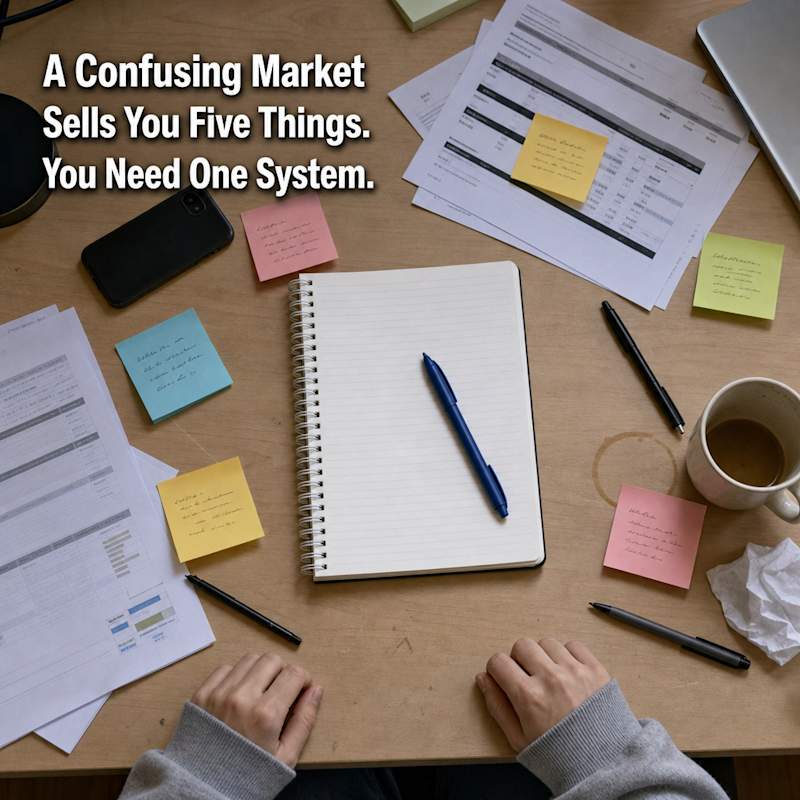
The LSAT prep industry doesn't make money by giving you one complete system and sending you on your way. It makes money by selling you the system in pieces — a course here, a supplement there, a logic games add-on, a reading comp workshop — and by convincing you that each piece requires their guidance to use correctly.
Think about what that incentive structure produces. A market where confusion is profitable. Where the answer to "what should I buy?" is always "more." Where a student with a dozen open tabs — 7Sage, Demon, Trainer, PowerScore, Kaplan — isn't experiencing a failure of research. They're experiencing a market that was designed to keep them browsing.
Analysis based on publicly available LSAT prep market pricing and structureThe prep companies aren't evil. They're businesses. And businesses price based on what the market will bear, not on what the method costs to deliver.
But that means something very specific for you, the person sitting at that checkout page right now: the price you're about to pay has almost nothing to do with the quality of the method you're about to receive.
A $1,000 course and a $60 book can teach the exact same six-stage reasoning process. The difference isn't in the system. It's in what's stacked on top of it — and whether you need what's stacked on top, or whether you need the system itself, clearly laid out, with a plan to follow it.
That's the question the industry hopes you never think to ask. See the full method breakdown and what's inside the bundle →
What a System-First Approach Actually Looks Like

Richard Brown is an LSAT strategist who built something the market doesn't naturally produce: one book that contains the entire process, start to finish, without upsells.
It's called the Score Accelerator Method™, and it's a six-stage system: Decode the Test, Build the Reasoning Core, Read with Precision, Expose the Trap Answers, Drill, Review, Refine, and Perform Under Pressure. Six stages. Connected. Sequential. Designed so a self-studyer can run the full method independently on test day — no tutor on speed-dial, no subscription expiring mid-prep.
The book is called The New LSAT Score Accelerator. It's 400 pages, 8.5×11", and it comes bundled with six tools — an 8-Week Self-Study Roadmap, an LR Trap Answer Field Guide, an RC Passage Map Workbook, an Error Log & Review Tracker, a Test-Day Confidence Checklist, and an Audiobook Edition. The bundle is $59.99.
How to Verify This Before You Spend a Dollar
Check the Method Structure
Look at the table of contents on the product page — all six stages are listed. Compare them to the curriculum outline of any $1,000 course.
Check the Bonuses
The 8-Week Self-Study Roadmap lays out exactly what to do each week. You can see what's included before you commit.
Check the Guarantee
30 days. If the system doesn't hold up to what's promised, you get your money back. The course won't offer you that after you've started.
Why Self-Studyers Are Taking a Closer Look

Here's what's verifiable before you buy:
The Score Accelerator Method™ is a named, structured, six-stage system — not a collection of tips repackaged under a new title. Each stage builds on the previous one. That's the architectural difference between a method and a content dump.
The book is 400 pages at 8.5×11" — a full-size study guide, not a pocket summary. The six bonuses — including a week-by-week roadmap and a dedicated trap-answer field guide — are included in the $59.99 price, not sold as add-ons.
Richard Brown's approach is explicitly anti-hype. From the method's own framing: "You do not rise to the level of your ambition. You fall to the level of your system." No overnight tricks. No secret shortcuts. A repeatable process you own and can run independently.
Nothing seems to be helping with LR— a self-studyer on 7Sage, describing the exact wall this method's trap-answer and reasoning-core stages are built to address
The 30-day money-back guarantee means you can work through the early stages, test the method against your own prep experience, and decide with evidence — not hope. This isn't for the person who wants someone else to do the thinking. It's for the person who's willing to do the work and wants a system that respects that willingness — without charging them $1,000 for the privilege. See what's inside the full bundle →
Can a $59 Book Really Replace a $1,000 Course?

Fair question. It's the first thing a smart researcher asks.
Here's the honest answer: it replaces the method — the six-stage reasoning process that every credible course teaches in some form. What it doesn't replace is a live tutor answering your questions in real time. If that's what you need to learn, a course might genuinely be worth it for you.
But if what you need is the system itself — clearly laid out, properly sequenced, with study tools that tell you what to do each week — then you're looking at a method-delivery question, not a method-quality question. And on method delivery, a focused 400-page guide with a week-by-week roadmap does something a drip-fed course doesn't: it gives you everything on day one.
The 30-day guarantee gives you time to open it, work through the first stages, and decide based on what you see — not on what you were promised. If it doesn't hold up, you send it back. That's not a sales pitch. That's a verification window.