Before You Pay $1,000 For An LSAT Course, Read What The Price Actually Buys
For self-studyers stuck on the same score and staring down a $1,000+ course invoice — here's what's really inside that price tag, and how much of it has nothing to do with fixing your plateau.


You know the feeling. Another practice test, another score that lands in almost the exact same place it did six weeks ago. You pull up the review, and it's not that you don't understand the material — it's that you keep missing the same kind of question, in the same way, for reasons you can't quite name.
On one 7Sage thread, a self-studyer put it plainly: "I'm currently stuck at -5/-6… The big question you need to identify is why you are in a plateau!" Another wrote it even more bluntly: "my score really stagnated on self study. I plateaued with no chance of improvement in sight." If either sentence made you wince a little, you're not alone, and you're not doing anything wrong by feeling stuck — plenty of careful, disciplined people hit exactly this wall.

So you start looking at what else is out there. And that's where the second problem shows up. Because the moment you open a comparison tab for a name-brand LSAT course, you're looking at a number with three zeros in it — sometimes more. You start doing the math nobody wants to do: tuition, or an LSAT course, or both. You wonder if the plateau is a "you" problem that only a bigger investment can fix, or something else entirely.
What The Big-Name Courses Are Really Selling You

Here's the thing a researcher deserves to know before comparing courses: a lot of self-studyers who've used the big-name prep books hit this exact wall. One forum post put it this way: "I also picked up my Loophole and LSAT Trainer books again, but nothing seems to be helping with LR." Not because those books are worthless — because more of the same material, studied the same way, doesn't fix a process problem. It just repeats it.
Now look at the course side of the comparison. People who've used the big prep programs will genuinely tell you they're strong — that's a real, earned opinion. Plenty of these programs teach a legitimate process.
"7Sage, to me, is the far better program for pushing your score higher."— self-studyer, 7Sage forum
But notice what that quote is actually describing: a process. Not a secret. Not something that can only exist inside a $1,000 login. A process — the same kind of thing that can be written down, sequenced, and put in a book. That doesn't mean courses are a scam. It means the price tag and the method are two separate things — and a smart researcher checks which one they're actually paying for.
The Question You Should Be Asking Instead

Here's the reframe that changes how you should be comparing your options in the first place: stop asking "which $1,000 course is the best one?" That question assumes the price and the process are the same thing. They're not. Ask this instead: what, specifically, am I being sold? A six-stage reasoning process — decoding the test, building your reasoning core, reading with precision, exposing trap answers, structured drill-and-review, performing under pressure — is describable. It can be written down. It can be taught in a book, an audiobook, a workbook, the same way it can be taught live for a thousand dollars.
$1,000+ — the typical entry price for a name-brand LSAT course. $59.99 — the price of the full six-stage method + $175 in study tools, in book form.
Price comparison — name-brand LSAT courses vs. the Score Accelerator Method™ bundleThat gap isn't a gap in substance. It's a gap in format and overhead. Once you see that, the whole decision changes shape. You're no longer choosing between "the cheap option" and "the real option." You're choosing between paying for delivery method, or paying for the process itself.
Ready to see exactly what you'd be paying for instead? Get The Full Comparison →
Meet The Book Built To Close That Gap

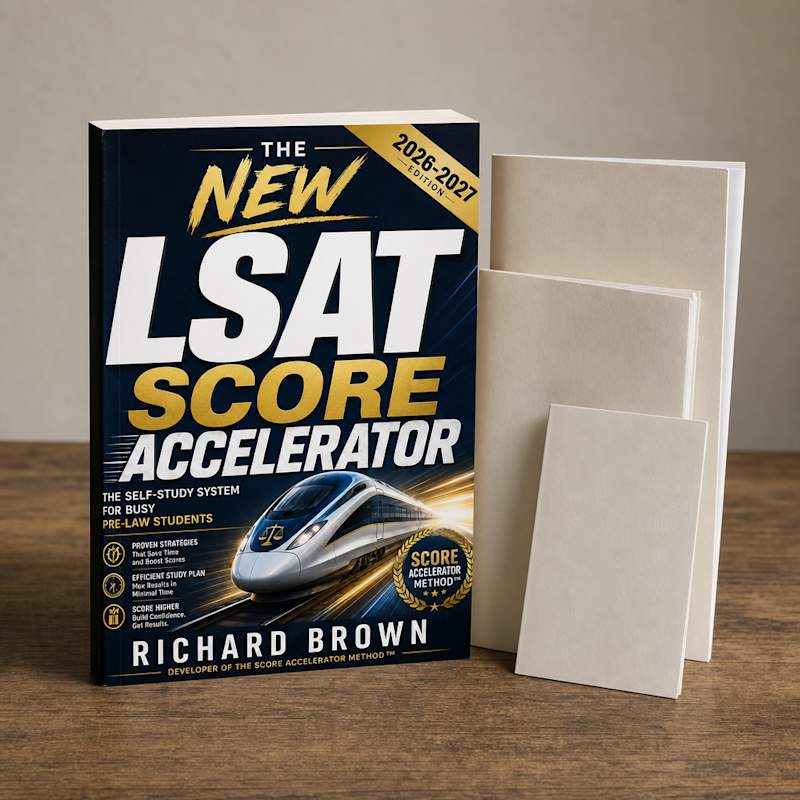
This is exactly the gap The New LSAT Score Accelerator by Richard Brown is built to close. It's the six-stage Score Accelerator Method™ — Decode the Test, Build the Reasoning Core, Read with Precision, Expose the Trap Answers, Drill/Review/Refine, Perform Under Pressure — written out in full, in a 400-page guide, with six companion tools ($175 stated value) instead of a login and a monthly bill. Brown's own line on it: "You do not rise to the level of your ambition. You fall to the level of your system." Not a trick. A system — the kind you're allowed to see in advance.
Here's how it stacks up on the things that actually matter to a researcher:
How To Verify This Yourself
Check The Structure
Ask any course or book for its actual breakdown — is it a named, sequenced method, or a loose stack of "tips"? A real process has stages you can name.
Watch The Promises
An honest, process-based resource talks about how you think through a question — not a guaranteed number of points.
Get The Return Window In Writing
Thirty days is enough time to actually work through a method before deciding if it's yours to keep.
What The Self-Study Community Already Knows
You don't have to take a marketing claim's word for the "process over grind" idea — the self-study community has been saying it for years, independent of any book or course. One frequently-echoed piece of advice on r/LSAT: "1 quality study hour a day… that's been a game changer." Not eighty hours a week. One focused hour, applied correctly.
"Improving your score requires you to fundamentally change the way that you read and think… look for steps or processes that you're trying to shortcut."— r/LSAT
That's the exact philosophy behind the Score Accelerator Method™ — and it's also the reason Richard Brown's material is explicit about not promising an overnight fix. No score guarantees, no "trick," no manufactured urgency. Just a named process you can inspect before you commit to it. For a researcher who's tired of vague promises, that plainness is the proof worth weighing. See The Full Method →
Can A $59.99 Book Really Do What A $1,000 Course Does?

The question every careful researcher asks at this point: "Can a $59.99 book really do what a $1,000 course does?"
Fair question — and the honest answer isn't "it's identical," it's this: the method itself doesn't require a classroom, a tutor's salary, or a marketing team to work. What it requires is a clear, sequenced process and the discipline to run it — both of which are in the book, in full. You're not paying less for the method. You're just not paying for everything else stacked on top of it.
And you don't have to trust that on faith. The 30-day money-back guarantee exists so you can actually open it, work a section, and decide for yourself before that decision costs you anything permanent.