Before You Pay $1,000 for an LSAT Course, Read This
For self-study LSAT candidates with a course pricing page open in one tab and a stalled practice score open in the other — the ones trying to work out what they're actually paying for before they commit a dollar.

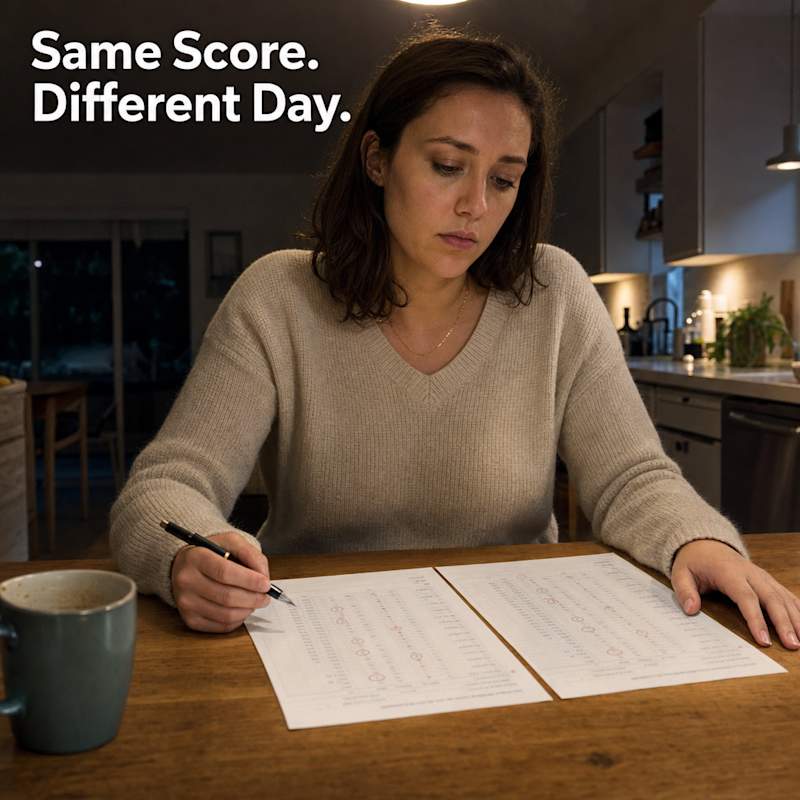
Two tabs. That's usually how this starts.
One tab has a $1,000-plus LSAT course sign-up page open — the payment plan calculator, the "enroll now" button, the countdown to the next cohort start date. The other tab has your last three practice test scores. Same number. Or close enough to the same number that it doesn't feel like progress anymore.
You know this feeling if you're here. "I'm currently stuck… the big question you need to identify is why you are in a plateau," is how one self-studyer put it — and it's not a rare complaint. Another: "my score really stagnated on self study. I plateaued with no chance of improvement in sight." That's not laziness talking. That's someone putting in real hours and getting a flat line back.

So now you're doing math nobody teaches you how to do. Is the course the missing piece — or just a fancier version of what already isn't working? If you spend the four figures and the score still doesn't move, do you get that money back, or do you get told to "just practice more"?
This is the part that costs you something real, even before you buy anything. It costs time — every week spent re-reading a book that isn't working is a week off your test date. It costs money-anxiety — the sunk cost already on your desk, plus the four-figure decision still ahead. And it costs something quieter: the sense that everyone else studying for this exam has a system, and you're the one still guessing.
You're not wrong to feel stuck. And you're not wrong to be suspicious of the next thing you're about to spend on before you know what it actually is.
Why What's Out There Falls Short

Here's what to watch for before you enroll in anything, or buy anything else.
Most of the big-name LSAT resources — the courses, the marked-up prep books, the tutoring packages — are selling you content. More practice sets. More video hours. More pages. And if your problem were a lack of material, that would work. But listen to how people who've actually used the well-regarded programs describe them: "7Sage, to me, is the far better program for pushing your score higher." Notice the word — program. Not a secret. Not a trick. A process, delivered at a price.
"I also picked up my Loophole and LSAT Trainer books again, but nothing seems to be helping with LR."— Self-Study LSAT Candidate, 7Sage Forum
That's the pattern worth flagging before you spend anything: stacking more material on top of material that already didn't move the plateau. The books and courses keep selling more input because their business model runs on subscriptions, tutoring hours, and course tiers — not on getting you to the finish line faster. There's no structural incentive for a $1,000 program to hand you a lean six-stage process and let you go. The longer you feel dependent, the longer the enrollment lasts.
That's not a conspiracy theory — it's just how the pricing lines up once you look closely. It's exactly why the plateau doesn't move: you keep adding volume to a process that was never the actual issue.
So before you pay for the next thing, the real question isn't "how much content do I get." It's a different question — and once you see it, it changes how you should be comparing your options.
The Pattern Interrupt

Here's the reframe.
Stop asking "which option gives me the most." Start asking: how much of this price is the actual method — and how much is everything built around it?
Every LSAT course has to pay for something besides teaching you to reason through a logic problem: ad spend to get you to enroll, tutor payroll, platform infrastructure, and — frankly — the framing that convinces you a self-guided guide "isn't enough." None of that is the six-stage reasoning process the test actually rewards. It's the overhead of delivering that process at scale, with a subscription price attached.
$1,000+ course price tag vs. a $59.99 guide carrying the same structural method plus $175 in stated-value study tools. That gap isn't a gap in substance. It's a gap in what you're being asked to fund.
Based on publicly known LSAT course pricing and program structures.Once you're evaluating prep this way, the decision stops being "expensive course vs. cheap book" and becomes "am I paying for the process, or am I paying for everything wrapped around the process." That's the question worth answering before you commit to either — the one most researchers never think to ask until after they've already paid.
Ready to see exactly where the money goes? See the Full Breakdown →
The Same Method, Without the Overhead

This is exactly the gap The New LSAT Score Accelerator by Richard Brown is built to close. It isn't a discount version of a course — it's the process itself, written down: the Score Accelerator Method™, a six-stage system — Decode the Test → Build the Reasoning Core → Read with Precision → Expose the Trap Answers → Drill, Review, Refine → Perform Under Pressure — trained as a way of thinking, not a pile of extra drills.
Brown's own framing: "You do not rise to the level of your ambition. You fall to the level of your system."
Before you decide between a course and a book, compare them on what actually matters:
Check These Three Things Before You Buy
Check the Stage Structure
Look at what a $1,000 course's syllabus actually outlines stage-by-stage, and compare it to a plainly listed six-stage method. Is the process genuinely different, or just differently packaged?
Check What the Price Includes
Ask any program directly what portion of the fee is instruction versus platform, marketing, or tutoring overhead.
Check the Guarantee Terms
Confirm you have a real window to test the method and get a refund if it isn't the fit — not just a vague "satisfaction promise."
The full stage-by-stage breakdown — the trap-answer logic, the 8-week roadmap, what's actually in the $175 bundle — is easier to see than to explain in an article. The next page lays it out in full.
What Test-Takers Who've Already Done This Say

You don't have to take a marketing claim's word for how the LSAT actually gets learned. Test-takers who've already been through the grind say it plainly:
"Improving your score requires you to fundamentally change the way that you read and think… look for steps or processes that you're trying to shortcut."— r/LSAT
That's the exact philosophy the Score Accelerator Method™ is built on — and it's also why the guide's own positioning refuses the "one weird trick" pitch you'll see everywhere in this category. No overnight promises. No shortcut sold as a secret. Richard Brown's approach is explicitly anti-hype: a repeatable, six-stage process, laid out in full — a 400-page guide, six supporting tools, one audiobook edition — built for a self-studyer to run independently, at their own pace, without a tutor's calendar dictating the timeline.
That's not a hype claim. It's a structural one you can check for yourself against the table of contents before you decide anything.
See it for yourself — See the Full Breakdown →
Can a $59 Book Really Do What a $1,000 Course Does?

The question every researcher asks at this point: "Can a $59 book really do what a $1,000 course does?"
Fair question — and the honest answer is that the book isn't trying to replicate the course's marketing budget, tutor payroll, or subscription infrastructure. It's built to replicate the process — the same six-stage method a well-regarded program would walk you through, minus the overhead that inflates the sticker price.
You don't have to decide that on faith. The guide comes with a 30-day money-back guarantee — enough time to work through the method, compare it to what you've already tried, and see for yourself whether the process holds up before you're locked into anything.